Small Engine Troubleshooting Guide 2025: Diagnosing Kawasaki, Honda, Kohler & Briggs Engines

By Ron | Certified Small Engine Mechanic | 15+ Years Experience | Last Updated: May 2025
A lawn mower that won’t start, runs rough, or loses power mid-mow is one of the most frustrating experiences a homeowner or landscaper can face. The good news: 90% of small engine problems are simple, predictable, and fixable without professional intervention if you understand the fundamentals. This guide provides a systematic diagnostic framework for the four most common engine brands found in lawn mowers in 2025: Kawasaki, Honda, Kohler, and Briggs and Stratton.
Chapter 1: The Four-System Diagnostic Framework
Every small gasoline engine requires four systems to be functioning correctly to start and run: Fuel, Air, Ignition, and Compression. All engine problems trace back to a failure in one or more of these four areas. Before reaching for any tools, work through these four systems systematically rather than replacing parts randomly.
System 1: Fuel
Modern ethanol-blended gasoline (E10 or higher) is the root cause of a remarkable number of small engine problems. Ethanol is hygroscopic — it attracts and absorbs water from the atmosphere. Over time (as little as 30 days), this causes fuel to degrade, separate into layers, and leave behind a varnish-like residue that clogs carburetor jets and passages. Always use fuel that is less than 30 days old and contains no more than 10% ethanol for any small engine application.
- Is there fuel in the tank? (Surprisingly often overlooked)
- Is the fuel fresh (less than 30 days old)?
- Is the fuel shutoff valve open (if equipped)?
- Is the fuel filter clear and unobstructed?
- Is fuel actually reaching the carburetor? (Remove the fuel line and confirm flow)
System 2: Air
A restricted air filter starves the engine of oxygen, causing rich running conditions, black smoke, power loss, and hard starting. Check and service the air filter before any other diagnosis.
- Paper element filters: tap out dust; replace if visibly dirty, oily, or torn
- Foam pre-filter: wash with warm soapy water, dry completely, apply a thin film of clean motor oil, reinstall
- Never use compressed air to clean a paper element — it tears the filter media, allowing unfiltered air to enter the engine
System 3: Ignition
The spark plug and ignition coil provide the electrical spark that ignites the fuel-air mixture. Diagnosis: remove the spark plug, reconnect the plug wire, hold the plug metal against the engine block, and crank the engine. A strong blue-white spark indicates a healthy ignition system. A weak yellow/orange spark, or no spark, points to a faulty plug, corroded boot connection, or failing ignition coil.
- Inspect the spark plug electrode: tan/gray = healthy; black/sooty = rich mixture or oil fouling; white/blistered = running lean or overheating
- Gap the new plug per the manufacturer’s specification (typically .030″ for most small engines)
- Check the ignition coil air gap (typically .010″–.014″ for most Kawasaki and Kohler coils)
System 4: Compression
Compression is what gives the fuel-air mixture the pressure it needs to ignite correctly. Low compression (below 90 PSI on most small engines) indicates worn piston rings, worn cylinder walls, damaged valves, or a blown head gasket. A compression tester costs under $20 and can save hundreds in unnecessary parts replacement. Low compression on an otherwise well-maintained engine is typically a sign that the engine has reached the end of its serviceable life.
Chapter 2: Brand-Specific Quirks and Known Issues
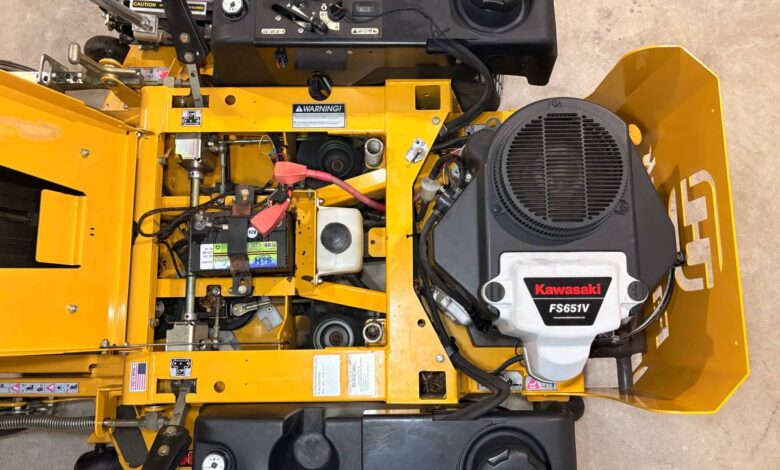
Kawasaki Engines (FR, FS, FX Series)
Kawasaki engines are the gold standard for longevity and commercial durability. The FR series (residential) and FX series (commercial) are found on nearly every premium zero-turn mower. Known issues and quirks:
- Oil Consumption: Many Kawasaki V-twins (especially FR651V, FR691V, FX730V) have a known tendency toward higher-than-expected oil consumption. Check oil levels every 5–8 hours during break-in (first 50 hours), not just at the standard intervals. Always carry a quart of oil on the mower.
- Valve Adjustment: Kawasaki OHV engines require periodic valve clearance checks (every 300 hours or as symptoms arise). Tight valves — particularly the exhaust valve — are a common cause of hard starting and power loss on high-hour Kawasaki units. Intake clearance: .004″–.006″; Exhaust: .006″–.008″.
- Carburetor Emulsion Tube Clogging: The emulsion tube (a small tube with drilled holes inside the carburetor) is notorious for clogging with ethanol varnish. Clean with carburetor cleaner spray directed specifically into this tube passage. Do not enlarge the holes.
Honda Engines (GCV, GX Series)
Honda small engines are renowned for reliability and fuel efficiency. The GCV series (residential) and GX series (commercial) power millions of walk-behind mowers and commercial equipment. Known issues:
- Auto-Choke Problems (GCV Series): Many Honda residential engines use an automatic choke system (linked to the throttle plate) rather than a manual choke. Over time, the auto-choke thermostat can stick in the closed position, causing a rich mixture condition that results in hard starting when warm, black smoke, and poor fuel economy. Cleaning the auto-choke mechanism often resolves this.
- Carburetor Bowl Drain Screw Corrosion: Honda carburetors have a drain screw at the base of the float bowl for winterization. This screw corrodes and can be impossible to remove without snapping it off. Annual replacement with a new screw (Honda part number) prevents this.
- Oil Alert System False Triggers: Honda GCV engines have an oil alert float that kills the engine if oil is low. The float itself can stick or corrode, triggering a shutdown even with adequate oil. If the engine shuts off suddenly and won’t restart, check oil first, then test the oil alert sensor by disconnecting it temporarily.
Kohler Engines (Command Pro, Courage, EFI Series)
Kohler is the second most popular engine brand in the commercial mower market. The Command Pro series is a direct competitor to Kawasaki FX, while the Courage series is found on residential equipment. Known issues:
- Courage Series Valve Guide Wear: The Kohler Courage SV (single-cylinder) series has a documented history of premature valve guide wear, causing oil consumption, blue smoke, and eventual engine failure. If you own a mower with a Courage engine and notice blue smoke, address it early — valve guide replacement is possible but requires disassembly.
- Command Pro EFI Throttle Body Deposits: EFI Kohler engines can develop carbon deposits on the throttle body plate and bore over time, particularly on engines that idle frequently. Periodic cleaning with throttle body cleaner and a soft brush restores smooth idle and throttle response.
- Stator/Charging System Failure: Kohler Command Pro engines have a known pattern of stator failure on high-hour commercial units. Symptoms: battery not charging, electrical accessories not functioning, and eventually the engine dying mid-use as the battery is depleted. A stator test with a multimeter (AC voltage output across the stator leads at running RPM) confirms diagnosis.
Briggs and Stratton (Intek, Professional, Vanguard Series)
Briggs and Stratton is the world’s largest small engine manufacturer and powers a huge proportion of residential lawn equipment. The Vanguard series represents their commercial offering. Known issues:
- Carburetor Bowl Gasket Failure: The fiber bowl gasket on many Briggs carburetors degrades when exposed to ethanol-blended fuels, causing fuel leaks from the base of the carburetor. Replacement gaskets are inexpensive and widely available.
- Primer Bulb Cracking: The rubber primer bulb on the simpler single-cylinder Briggs engines (Quantum, Intek) becomes brittle and cracks within 3–5 years. A cracked primer bulb delivers no fuel to the carburetor, causing hard or no-start conditions. Replacement is a simple 2-minute fix.
- Intek Twin Cylinder Oil Leaks: The Briggs Intek V-Twin has a pattern of developing valve cover gasket leaks on higher-hour units. These leaks cause oil to drip onto hot exhaust components, creating smoke and a fire risk. Gasket replacement is straightforward with basic tools.
Chapter 3: Step-by-Step Diagnostic Sequences
Engine Won’t Start (Cold)
- Confirm fuel in tank; confirm fuel shutoff is open
- Check choke position — cold start requires full choke on most engines
- Pull primer bulb 3x if equipped
- Check safety switches: seat switch, bail handle, blade engagement (all must be in correct position)
- Remove and inspect spark plug — replace if fouled or more than 100 hours old
- Verify spark: hold plug against block and crank — blue-white spark = ignition OK
- If no spark: test ignition coil, check kill wire for short to ground
- If spark present but no start: confirm fuel reaching carb, clean carburetor
Engine Starts But Stalls Immediately (or After Warming Up)
- Suspect carburetor — specifically clogged idle circuit or main jet. Remove and clean thoroughly
- Check fuel cap vent — a blocked cap creates a vacuum in the tank that starves the carburetor. Loosen cap and try starting again to test
- Check for air leak at carburetor-to-intake mounting gasket (spray carburetor cleaner around the joint while running — RPM change indicates a leak)
- On auto-choke engines (Honda GCV), test choke operation and clean the choke mechanism
Engine Surges at Idle or Part Throttle
Surging (rhythmic RPM oscillation) is almost universally a carburetor problem. Specifically: partially clogged main jet or emulsion tube. The engine is receiving inconsistent fuel delivery, causing the governor to hunt for equilibrium. Clean the carburetor thoroughly, with particular attention to the emulsion tube and all drilled passages. If surging persists after thorough cleaning, replace the carburetor — they are inexpensive on residential engines.
Engine Knocks or Rattles
A metallic knocking sound under load is a serious symptom. Possible causes: low oil (check immediately), loose flywheel key (the flywheel key shears when the blade hits a solid object, retarding the ignition timing), worn connecting rod bearings (end-of-life indicator), or carbon buildup on the piston (causes pinging/detonation). Stop the engine immediately and diagnose before further use.
Chapter 4: When to Repair vs. Replace the Engine
Small engines can often be repaired for a fraction of replacement cost — but not always. Use this framework:
- Repair makes sense: Carburetor problems, ignition issues, valve adjustments, gasket replacement. These are cheap parts with significant lifespan remaining in the engine block and internals.
- Evaluate carefully: Piston ring replacement, valve guide replacement. Labor intensive. Only worthwhile if the rest of the engine (crankshaft, bearings, cylinder bore) is in excellent condition.
- Replace the engine or mower: Spun main bearing, seized engine, cracked block, or bent crankshaft. Replacement engines are widely available — often cheaper than major internal repairs.
For complete mower maintenance best practices beyond the engine, read our Mower Maintenance Master Guide and our Zero-Turn Mower Guide.
Conclusion
Small engine diagnosis is a learnable skill. By working through the four systems — fuel, air, ignition, compression — systematically and understanding the specific patterns of each major brand, you can resolve the vast majority of engine problems yourself. The money saved on dealer labor alone will return the value of this knowledge many times over.
About the Author: Ron is a certified small engine mechanic with 15+ years of professional experience diagnosing and repairing Kawasaki, Honda, Kohler, and Briggs engines in commercial and residential equipment.
