Commercial Landscaping Equipment Guide 2025: Choosing, Operating & Scaling Your Fleet

By Ron | Lawn Care Equipment Specialist | 15+ Years Experience | Last Updated: May 2025
Running a landscaping business means making equipment decisions that directly affect your profitability, crew safety, and client satisfaction. The wrong mower on a commercial route can cost you thousands in downtime, repairs, and lost contracts. This guide gives professional landscapers a comprehensive framework for selecting, operating, and maintaining commercial-grade equipment in 2025.
Chapter 1: Commercial vs. Residential Equipment – The Real Differences
The word “commercial” is often misused in marketing. True commercial equipment is not just a heavier version of residential – it is built to fundamentally different specifications. Here is what separates a genuine commercial mower from a prosumer unit:
- Duty Cycle: Commercial mowers are engineered for 6-10 hours of daily use, 5-6 days per week, for years. Residential/prosumer units are rated for 1-2 hours per week.
- Frame Construction: Commercial frames use thicker-gauge steel and more welded joints. Stamped components are replaced by fully fabricated assemblies.
- Engine: Commercial units use industrial-spec engines (Kawasaki FX series, Kohler Command Pro) with pressurized lubrication systems, full-pressure oil filters, and extended service intervals.
- Transmissions: Heavy-duty hydrostatic pumps and wheel motors (Parker, Hydro-Gear commercial series) rated for thousands of operating hours.
- Warranty: Commercial warranties cover defects under actual commercial use conditions.
Chapter 2: Essential Commercial Equipment Categories
Stand-On Mowers
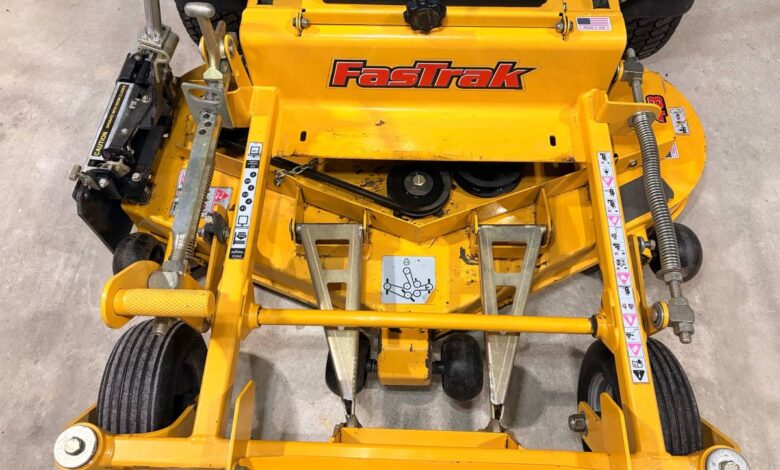
Stand-on mowers have become the dominant machine on professional routes for good reason. They offer zero-turn maneuverability in a compact package that is easier to load and unload from trailers, reduces fatigue compared to walk-behinds, and takes up less trailer space than a sitting zero-turn – critical when billing by the property per day. The Bad Boy FX730V Revolt Stand-On is an excellent example of the category’s evolution in 2025.
Commercial Zero-Turn Mowers
For open properties with minimal obstacles (parks, sports fields, large estates), a commercial sit-down zero-turn is the most productive machine available. Brands like Scag, Exmark, Ferris, and Grasshopper build machines that can run 8 hours per day with only basic daily maintenance. Key differentiators at this level: suspension systems (Ferris IS-series), diesel engines (Grasshopper 700D series), and wide 61″-72″ decks that cover enormous ground per pass.
Commercial Walk-Behind Mowers (Hydro Walk)
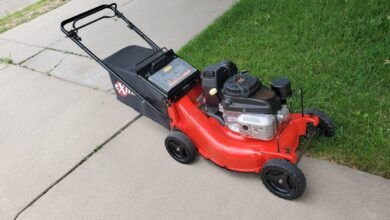
For properties with lots of obstacles, slopes, or terrain that a riding mower cannot safely navigate, a commercial hydrostatic walk-behind is the professional’s choice. Unlike residential self-propelled mowers, commercial hydro walks allow the operator to reverse quickly without stopping – dramatically increasing efficiency on complex properties.
Backpack Blowers, Trimmers & Edgers
A complete commercial operation requires a full complement of hand-held equipment. The most important spec for commercial blowers is air volume (CFM) rather than air speed (MPH). A high-CFM blower (600+ CFM) moves large volumes of clippings quickly. For trimmers, a straight-shaft design is required for commercial use – curved-shaft trimmers are consumer tools not designed for daily use.
Chapter 3: Building a Commercial Fleet – The Right Order of Acquisition
For new landscaping businesses, the order in which you acquire equipment determines your initial profitability. Over-investing in equipment before you have the route to justify it is a common and dangerous mistake.
Phase 1 (Launch – 5-15 residential clients): One commercial walk-behind hydro mower, one commercial backpack blower, one commercial straight-shaft trimmer, one dedicated trailer. Total investment: $8,000-$12,000. This setup can service 5-12 residential properties per day with one operator.
Phase 2 (Growth – 15-40 clients): Add a 48″-52″ commercial sit-down zero-turn or stand-on mower for larger properties. Add a second trimmer and second blower for crew work. Total addition: $8,000-$14,000.
Phase 3 (Scale – 40+ clients, multiple crews): Invest in a second trailer, a second zero-turn, and commercial-grade edgers. Begin evaluating whether GPS fleet tracking software justifies its cost (it does, once you have 3+ crews).
Chapter 4: Commercial Equipment Maintenance – Zero Downtime Strategy
In a commercial landscaping operation, every hour of equipment downtime costs money in two ways: the direct cost of repair AND the lost revenue from properties you cannot service. Eliminating unplanned downtime through preventive maintenance is the highest-ROI activity in fleet management.
Daily Maintenance Protocol (The “15-Minute Rule”)
Every commercial mower should receive a 15-minute inspection at the end of each work day, not the beginning. If a problem is found at the end of the day, you have until the next morning to fix it. Found at the beginning of the day, it disrupts your schedule immediately.
- Blow out the engine compartment and air filter housing with compressed air
- Check and top off engine oil
- Check hydraulic fluid sight glass
- Inspect blade belt condition and tension
- Clean deck underside
- Grease all daily-interval zerks
- Inspect tires for embedded debris (wire, nails, glass – these are everywhere on commercial properties)
Weekly Maintenance (Every 50 Operating Hours)
- Sharpen or rotate blades. On commercial operations, carry pre-sharpened spare blades and swap them mid-week – never stop to sharpen blades in the field.
- Full grease of all zerks per the service schedule
- Air filter inspection and service
- Belt tension adjustment
- Check all safety systems (seat switch, blade engagement, parking brake)
Monthly Maintenance (Every 100-150 Operating Hours)
- Engine oil and filter change
- Fuel filter replacement
- Spark plug inspection and replacement if needed
- Full deck blade spindle bearing inspection
- Hydraulic system level check and full inspection
Chapter 5: Cost of Ownership Analysis
Understanding the true cost of commercial equipment is essential for accurate job pricing. Many landscapers underscore equipment costs by only counting the purchase price and ignoring ongoing expenses.
True Annual Cost Formula: (Purchase Price / Lifespan in Years) + Annual Maintenance + Fuel Costs = Annual Equipment Cost Per Machine.
Example for a $9,000 commercial zero-turn with a 7-year lifespan: $9,000/7 = $1,286 depreciation + $800 annual maintenance + $1,200 annual fuel (at 1 gallon/hour, 600 hours/year, $2/gallon) = $3,286 per year, or approximately $6.30 per operating hour. This number must be reflected in your pricing.
Chapter 6: Safety on Commercial Operations
The commercial landscaping industry has an injury rate significantly higher than the national average for all industries. The most common causes: entanglement with rotating blades, rollover on slopes, and repetitive strain injuries from prolonged equipment operation.
- Always wear hearing protection (commercial engines at 90-95 dB cause measurable hearing loss over a career)
- Steel-toed boots are non-negotiable
- Eye protection during blowing and trimming operations
- Train all crew members on slope limits for every machine in the fleet before they operate independently
- Never allow passengers on riding equipment
For residential lawn care guidance to pass on to your clients, refer to our complete mower maintenance guide and our zero-turn buyer’s guide.
Conclusion
Building and maintaining a commercial landscaping fleet is as much a business discipline as it is a mechanical one. Invest in the right equipment for your current route size, implement a rigorous preventive maintenance program, and know your true cost-per-operating-hour. These habits separate the landscaping businesses that scale from those that stay stuck.
About the Author: Ron is a certified small engine mechanic and commercial equipment specialist with 15+ years of hands-on experience servicing and reviewing professional-grade outdoor power equipment.