Riding Lawn Tractors in 2025: The Complete Buying, Maintenance & Comparison Guide

By Ron | Lawn Care Equipment Specialist | 15+ Years Experience | Last Updated: May 2025
For millions of homeowners, the riding lawn tractor represents the perfect balance: more power and speed than a push mower, yet more affordable and maneuverable than a full-sized zero-turn. If your property is between 0.5 and 3 acres, a riding tractor is likely your best investment in lawn care equipment. This guide covers everything you need to know to choose, operate, and maintain yours for 15+ years of reliable service.
Chapter 1: Anatomy of a Riding Lawn Tractor
Before you can buy the right tractor, you need to understand what separates a good one from a mediocre one. Riding lawn tractors come in two basic configurations: front-engine tractors (the classic look, with the engine hood in front of the operator) and rear-engine riders (a more compact design where the engine sits behind the seat, like the Craftsman R140).
Front-Engine Tractors – The Dominant Design
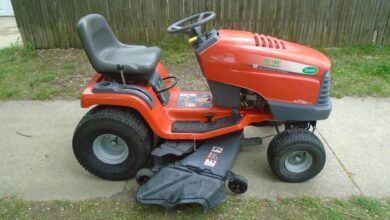
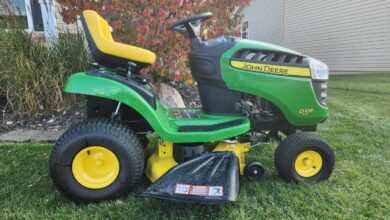
Front-engine tractors are the most common type sold today. The engine is mounted ahead of the operator, which provides excellent weight distribution and makes the engine easily accessible for maintenance. The steering is handled by a standard steering wheel connected to the front axle, making them intuitive to operate for anyone who can drive a car.
Within front-engine tractors, there are two further distinctions: Lawn Tractors (lighter, suited for flat terrain, typically 30″-46″ decks) and Garden Tractors (heavier-duty machines built for diverse terrain and attachments, like snow blowers and tillers). If your primary goal is mowing, a lawn tractor is usually sufficient. If you want a true year-round workhorse, invest in a garden tractor.
Key Components
- The Engine: Single-cylinder engines (10-14 HP) are found on entry-level models. Twin-cylinder engines (18-25+ HP) provide smoother operation, more torque for dense grass, and longer service life. Always prefer a twin-cylinder if budget allows.
- The Transmission: This is the most critical decision. Manual (gear-shift) transmissions are durable but require foot clutching. CVT (continuously variable) and hydrostatic transmissions allow on-the-go speed adjustment without clutching – a massive quality-of-life improvement. Hydrostatic is the gold standard.
- The Cutting Deck: Stamped steel decks (common on budget models) are adequate for flat terrain. Fabricated decks (welded from thick steel sections) are stiffer, more durable, and produce a better cut. Deck widths of 42″ to 54″ cover most residential needs.
- The Steering: Look for tight steering with minimal play. Loose, sloppy steering makes it difficult to cut straight lines and navigate around obstacles.
Chapter 2: 2025 Buyer’s Guide – Choosing Your Tractor
Budget Tiers
Entry-Level ($1,500-$2,500): Single or small twin-cylinder engines, stamped decks, gear or CVT transmissions. Adequate for flat 1-acre lots mowed weekly. Look at: Husqvarna YTH18542, Cub Cadet XT1, Troy-Bilt TB30R.
Mid-Range ($2,500-$4,000): The sweet spot. Twin-cylinder engines, hydrostatic transmissions, fabricated or heavy-gauge stamped decks, comfortable high-back seats, cruise control. Look at: John Deere X370, Husqvarna YTH24V54, Ariens Edge 46.
Premium Garden Tractor ($4,000-$8,000+): Cast-iron front axles, powerful twin-cylinder engines (22-25+ HP), heavy-duty fabricated decks, and PTO compatibility for year-round attachments. Look at: Cub Cadet XT2 LX54 FAB, Husqvarna GTH26V54LS, John Deere X580.
Questions to Ask Before Buying
- What is my terrain like – flat, hilly, or mixed? (Hills require more power and better traction.)
- Do I need to use attachments (snowblower, bagger, aerator)? If yes, invest in a garden tractor with a rear PTO and compatible attachment system.
- What is my gate width? Many riding tractors are 46″-54″ wide at the widest point – wider than the cutting deck – so check access points before buying.
- Is local dealer support available? For long-term ownership, having a nearby authorized service center for parts and warranty repairs is invaluable.
Chapter 3: Operating Your Riding Tractor Safely
Starting Procedure
- Engage the parking brake before starting.
- Ensure the PTO/blade engagement is in the OFF position.
- Sit in the operator seat to activate the safety seat switch.
- Move the throttle to half-choke for cold starts, or full choke in very cold weather.
- Turn the key. Once the engine catches, move the choke to the fully open (run) position.
Mowing Best Practices
The 1/3 Rule: Never cut more than one-third of the grass blade height in a single mowing session. Cutting too short (scalping) stresses the grass, promotes weed invasion, and increases water requirements. If the lawn is overgrown, mow at a high setting first, then lower the deck on the next pass.
Overlapping Passes: Overlap each pass by 3-6 inches to ensure no strips of uncut grass are left behind, particularly important as blades dull or deck belts loosen.
Direction Changes: Unlike a zero-turn, a riding tractor requires wide sweeping turns at the end of each row. Maintain forward momentum through turns to avoid turf-tearing from aggressive pivoting on a stationary rear wheel.
Slope Safety
Riding tractors are more stable on slopes than zero-turns (thanks to front-wheel steering), but they are still dangerous if misused. Follow these rules:
- Mow across slopes (horizontally) rather than up and down – the opposite of ZTR guidance. The four-wheel steering contact keeps the tractor from sliding.
- Never exceed a 15-degree slope (check your owner’s manual – some tractors are rated only to 10 degrees).
- Disengage the cutting deck before making turns on steep slopes.
- Never mow wet slopes. Wet grass eliminates traction immediately.
Chapter 4: Comprehensive Maintenance Schedule
Before Each Use
- Check engine oil level (never start a low-oil engine).
- Inspect the cutting blades through the deck discharge chute for visible damage.
- Check fuel level. Avoid running the tank completely empty – sediment from the bottom of the tank can clog the carburetor.
Every 25 Hours (Monthly)
- Clean or replace the air filter. A dirty filter is the most common cause of power loss and excessive fuel consumption.
- Check and inflate tires. Uneven tire pressure creates an uneven cut. Front tires typically run 14 PSI; rear tires 10-12 PSI.
- Grease front axle and deck pivots. Use a grease gun on all accessible zerks. Pay special attention to the front axle pivot, which bears the most stress during turning.
Every 50 Hours (Mid-Season)
- Sharpen cutting blades. A properly sharpened blade makes a clean cut at a 30 degrees angle. A dull blade tears, which causes brown tips and encourages disease. Remove blades, sharpen, and balance on a blade balancer before reinstalling.
- Inspect and adjust blade drive belt. The belt connecting the engine PTO to the deck spindles stretches over time. Consult your manual for the correct tension specification and belt replacement procedure.
- Check deck leveling. Place the tractor on a flat, hard surface. Measure blade tip height at four points around the deck (front, back, left, right). Front-to-back level should tilt slightly downward toward the front (1/4″ to 3/8″ lower in front) for optimal cut quality.
Every 100 Hours (Annual Service)
- Oil and filter change. The single most critical maintenance task. Use the viscosity specified in your owner’s manual – typically SAE 30 for warm climates, 10W-30 for year-round use, or full synthetic 5W-30 for cold winters.
- Spark plug replacement. Check the old plug’s condition: tan/gray = healthy; black and sooty = rich mixture or oil burning; white/chalky = running lean. Replace with the manufacturer-specified plug, properly gapped.
- Fuel filter replacement. An old, varnished fuel filter severely restricts flow, causing hard starts and rough running.
- Battery load test. A battery that passes a standard voltage test can still fail under starting load. Have your local dealer test the battery under load before the season.
- PTO clutch inspection. Electric PTOs are vulnerable to heat damage from repeated cycling. Check the air gap between the clutch armature and rotor (typically 0.010″-0.020″) and adjust if necessary.
Hydrostatic Fluid Service
Many homeowners don’t realize that their hydrostatic riding tractor transmission contains hydraulic fluid that degrades over time. On tractors with a serviceable transaxle, change the fluid per the manufacturer’s schedule (typically every 200 hours or every 2-3 years). Neglecting this accelerates internal wear and eventually causes the transaxle to overheat and fail – a repair that costs $500-$1,500.
Off-Season Winterization
- Add fuel stabilizer to the tank and run the engine for 5 minutes to distribute it throughout the fuel system.
- Change the engine oil before storage (old oil contains combustion acids that corrode internal surfaces).
- Remove the battery, charge it fully, and store in a temperature-controlled space on a battery maintainer.
- Engage the parking brake, lower the deck, and cover the tractor.
Chapter 5: Common Problems & Troubleshooting
Engine starts but stalls immediately: Classic carburetor issue from old, varnished fuel. Clean the carburetor float bowl and jets with spray carburetor cleaner. Replacing the fuel filter is often sufficient.
Tractor won’t move (hydrostatic): Check the hydrostatic bypass rod/lever – many models have a bypass lever for easy pushing that, if accidentally left engaged, prevents drive. Also check the drive belt from the engine to the hydrostatic unit for breakage.
Deck vibrates violently: A broken, bent, or missing blade. Stop immediately – an unbalanced deck can damage spindle bearings and even the deck frame itself. Inspect all blades and replace any damaged ones.
White/blue smoke from exhaust: Oil burning, typically from worn piston rings or valve seals. A small amount of smoke on cold starts is normal; persistent smoke during operation requires a dealer inspection.
Steering feels heavy or pulls to one side: Low tire pressure is often the cause. Also check for bent tie rods or front axle damage after any impacts with curbs or obstacles.
Chapter 6: When to Repair vs. Replace
This is the most practical question for long-term owners. As a general rule: if the cost of a single repair exceeds 50% of the machine’s current market value, seriously evaluate whether replacement makes better financial sense.
Key indicators that repair is worthwhile: the engine runs well (engines are the most expensive component), the frame is straight and rust-free, and parts are readily available. Key indicators to consider replacement: a seized engine, a failed hydrostatic transaxle on a non-serviceable unit, or severe deck rust-through on a cheaper model.
If you’re buying a replacement or upgrading, explore our guide to buying a used lawn mower – you can often find excellent prosumer-grade machines at a fraction of new prices. For those considering a step up in performance, read our Complete Zero-Turn Mower Guide to understand when the upgrade makes sense.
Conclusion
A well-chosen riding lawn tractor, properly maintained, will give you a decade or more of dependable service and transform what was once a grueling chore into a manageable – even enjoyable – routine. Match the machine to your terrain and acreage, invest in annual service, and you’ll never need to question your investment.
About the Author: Ron is a certified small engine mechanic and lawn care equipment specialist with over 15 years of professional experience testing, servicing, and reviewing outdoor power equipment. All recommendations on RonMowers.com are based on hands-on field experience.
About the product
About the seller
Name:
Contact the seller